On the one hand, concrete is one of the most durable building materials, on the other hand, it is strongly susceptible to the negative influence of various external factors. In fact, there is nothing difficult about initially preventing the destruction of concrete. To do this, it is necessary to strengthen the surfaces with special compositions for concrete, such as toppings, varnishes, impregnations, etc. If this is not done, or use an unsuitable hardening compound, or do it too late, then the appearance of cracks will be quite understandable. What should I do if they have already appeared?
Firstly, it is necessary to deal with the types of cracks, and then select the material for their elimination.
 What types of cracks are there?
The classification of cracks occurs for several parameters:

- For size: these can be microcracks with a width of 1 mm, medium cracks - up to 10 mm, as well as large ones with a width of more than 10 mm.
- Behind the location in concrete: through or surface. And those, in turn, may differ in depth. There may also be cracks that are located near the exposed fittings, which caused their appearance.
- For the location and quantity: cracks. which have arisen locally in one part of the surface, over the entire area of concrete, or only in the most sensitive parts of the structure - at corners and bends.
- The reason for the appearance: cracks that have arisen due to the shrinkage of the structure, and cracks that have arisen during operation.
- For the impact on the structure: minor cracks that do not affect the integrity of the reinforced concrete structure and cracks that affect its strength and integrity.
After analyzing the type of crack, you can proceed to the stage of material selection.
How to choose a material for sealing cracks?
There are quite a lot of types of materials to eliminate cracks.
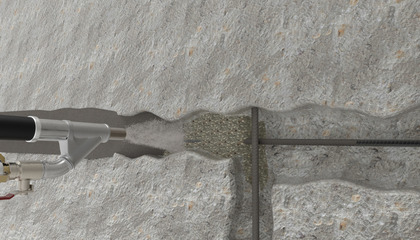 These include repair compounds, sealants, bulk compounds, epoxy resins and others. Below are some examples of cracks and materials for their elimination.
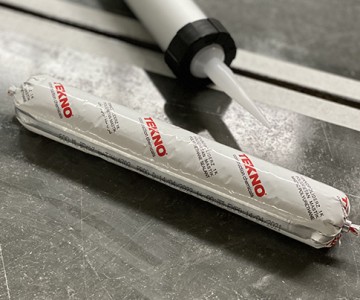
If it is necessary to seal up long cracks with a width of about 10 mm, then the most suitable material will be a sealant, for example, Teknopoliderz 1K based on polymers. It is suitable for the elimination of both horizontal and vertical seams.
If there are a lot of cracks on the surface, but they are small and shallow, then the ideal material is a liquid mixture that will cover the entire surface with a uniform layer. We advise you to pay attention to the Teknoself material. It is applied in a layer from 2 to 10 mm, which is perfect for eliminating cracks of this kind. And, in addition, the liquid mixture will additionally strengthen the concrete surface, since there are synthetic polymers in the composition, which increase the strength of the material.
If the cracks are large enough, then only a cement-based repair mixture will help here. For example, Teknogrout EX for cracks that have formed on horizontal surfaces or Teknorep 300 for cracks on vertical surfaces.
We hope our article was useful for you. If you are not sure about the correct definition of the type of cracks, then call 067 486 42 41 and get free advice and assistance in the selection of materials.