Despite the fact that building materials such as foam block and gas block are similar in their characteristics and applications, they should not be confused.
In this article we will tell you what is the difference between these materials and their features.
 Where is foam block and gas block used?
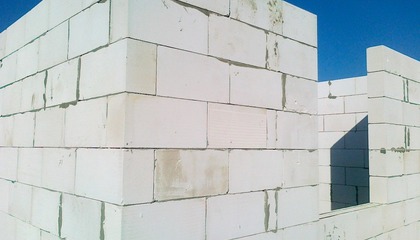 The scope of use of foam block and gas block is very similar. They cannot be used to build load–bearing walls, but any partitions are welcome.
The foam block is used for:
- Filling of the monolithic frame;
- The construction of partitions;
- Construction of three-layer walls;
The gas block is used for:
- Construction of internal and curtain walls;
- Construction of houses up to 3 floors high;
- Construction of fences;
- Construction of baths.
What material is used for laying foam blocks and gas blocks?
Both for laying foam blocks and for laying gas blocks, the same cement-based adhesive material with polymers in the composition is usually used. The glue should provide a high degree of fixation of the blocks for centuries. This is the material Teknofay 500 from the imported manufacturer Tekno.
 Differences between the foam block and the gas block behind the composition
Both materials belong to the cellular type of concrete. They are similar in appearance and composition, but there are a couple of differences.
 The foam block consists of the following components:
- Water;
- Cement;
- Sand;
- Foaming agent.
The gas block consists of:
- Water;
- Cement;
- Quartz sand;
- Gas - forming agent;
- Calcium oxide.
What are the features of the foam block?
In order to achieve a foamy structure of the material, special foaming agents are added to the solution during production, after which everything is foamed and poured into the formwork for solidification.
When creating foam blocks, a non-autoclave hardening method is used. That is, the material hardens in the formwork naturally. Depending on the type of formwork, we get either ready-made blocks at once, divided into even parts in the formwork, or one solid block that needs to be cut into even parts.
The mass of one foam block is 22.6 kg.
The moisture absorption index is 14%.
The compressive strength ranges from 0.25 to 12.5 MPa.
What are the features of the gas block?
 In the manufacture of gas blocks, special gas-forming agents are used, which ensure the porosity of the material. The hardening method when creating gas blocks is autoclave, according to the principle of operation of which the liquid material is placed in autoclaves for 12 hours and perfect homogeneous blocks are obtained.
The mass of one gas unit is 19.26 kg.
The moisture absorption index is 20%.
The compressive strength ranges from 0.5 to 25 MPa.