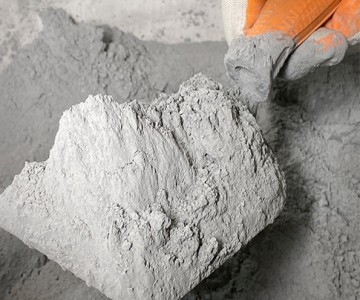
Decorative printed concrete is quite a popular type of decorative coating in the XXI century. It is easy to apply, not picky to use and with its help you can create an imitation of a variety of expensive decorative materials.
If you doubt whether such a floor covering will suit you, we suggest you familiarize yourself with all the pros and possible cons of decorative printed concrete, which we have specially collected in this article.
 Features of Decorative printed concrete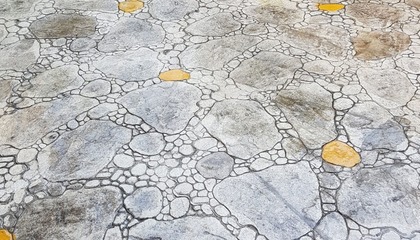
The main feature of decorative printed concrete is that thanks to a wide variety of stamps and a large palette of colors, you can create a wide variety of patterns on concrete.
Another important feature is that, simultaneously with the creation of a decorative coating, the strength and durability of the surface improves.
Also, if all the steps are performed correctly when working with the material, printed concrete becomes part of the concrete structure.
 What are the advantages of using printed concrete?
The main advantages of printed concrete include:
- Creating a beautiful decorative surface with the ability to imitate paving slabs, natural stone, parquet and other types of decorative coatings;
- High wear resistance of the surface: the abrasion is less than ≤ 5.5 cm3/50 cm2.
- Protection of concrete from damage due to mechanical shocks: the strength of the surface with decorative printed concrete is more than 50 N/mm2;
- Prevention of dust formation;
- Protection against damage under the influence of moisture;
- Ensuring resistance to peeling of the decorative coating as a result of freezing and thawing cycles.
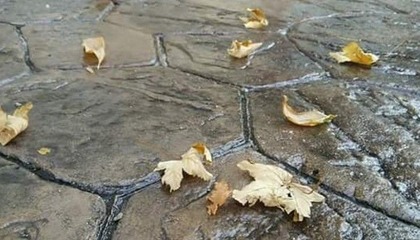
Depending on the manufacturer, the technical characteristics and color scheme of the material may vary. The imported manufacturer Tekno offers high-quality printed concrete at an affordable price in any color from the RAL palette. You can find it under the name Teknoser Baski.
What are the disadvantages of using printed concrete?
Of the disadvantages , the following can be distinguished:
- the material is not compatible with concrete in which fly ash or other types of mineral impurities have been added;
- the material can be used exclusively on freshly laid concrete;
- working with the material requires high concentration and speed of work, so a beginner alone may not be able to cope with the high-quality creation of printed concrete. It is better to hire professional workers.
- When applying the material for printed concrete, you need to be extremely careful and distribute it in a uniform layer (standard from 3 to 5 kg / m2).
Although, some of the above points are rather not minuses, but recommendations when working with the material.