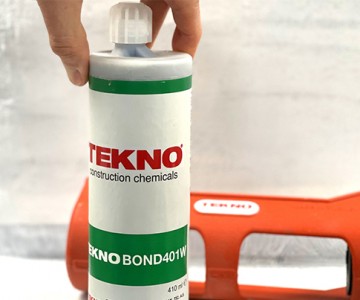
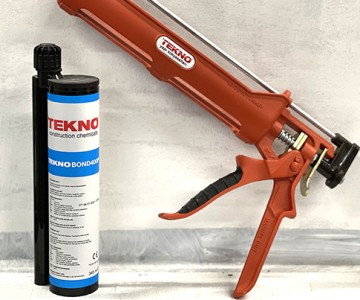
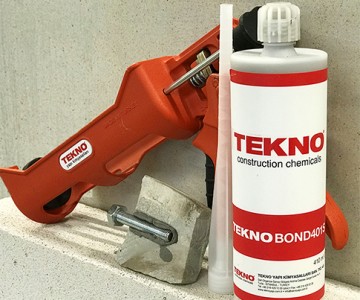
The Internet is teeming with information about the advantages of chemical anchors, about their usefulness in the construction industry and that many craftsmen prefer to work with them rather than with mechanical ones.
Are chemical anchors really that good? Or do they still have some drawbacks? Let's try to answer these questions in our article.
 What is the principle of operation of chemical anchors?
Chemical anchors fix various elements due to properties such as high adhesion and cohesion in the base.
 First, a hole of the required length and diameter is drilled, after which it is cleaned and filled with a chemical composition. After filling, a stud or a reinforcing rod is inserted into the hole. As soon as the composition is completely solidified, it can be loaded.
What is the main advantage of a chemical anchor over a mechanical one?
The main advantage of chemical anchors is a wider scope of operation.
This is due to the possibility of mounting not only in a solid, solid solid base, as with conventional mechanical fasteners, but also in hollow, loose bases, as well as in the edges and corners of structures.
 The chemical anchor fills all the voids of the bases, fastening them together, thereby creating a reliable, durable fastening. In addition, the weight of the attached element is distributed over the entire length of the anchor, which also makes the fastening more durable and reliable.
Also, a chemical anchor does not have such a phenomenon as the appearance of rust, which is very common among mechanical ones.
Are there disadvantages of chemical anchors?
Today, there are no analogues of chemical anchors, especially when it is necessary to attach a heavy element to a hollow base.
Despite this, the material still has several disadvantages.
Unpleasant smell: it's a chemical composition after all.
Work without smoke breaks: the material freezes within 7-10 minutes, so if it is necessary to fill not 1-2 holes, then you will have to work very quickly, but carefully.