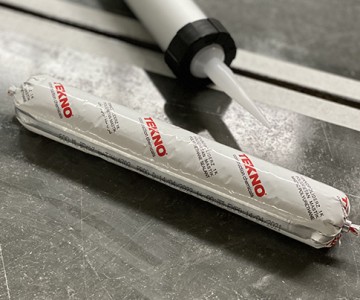
Incorrect pouring of concrete or incorrect operation of concrete floors leads to the same consequences - the appearance of cracks. Today there are hundreds of types of materials that are designed both to prevent their appearance initially and to eliminate them if this has already happened. Of course, it is recommended to seal up cracks immediately, without waiting for their proliferation and destructive effect on the entire reinforced concrete structure.
 In this article we would like to talk about some types of materials with which it is possible to quickly and efficiently eliminate various types of cracks.
 Sealant
The sealant is suitable for sealing long and relatively smooth seams with a width of 10 mm to 30 mm.
An excellent example is the polyurethane sealant Teknopoliderz 1K. This material has a very high adhesion, so it can be used on various surfaces, such as concrete, brick, wood, metal, aluminum and PVC products.
The sealant has a very wide scope of application: from residential premises to massive reinforced concrete structures. Among the advantages of the material are:
 high strength;
- wear resistance;
- moisture resistance;
- high adhesion;
- resistance to aggressive environment;
- resistance to temperature changes;
- UV resistance;
- wide operating temperature range.
In addition to the above advantages, the sealant is easy to use, since the material does not require kneading, it is already ready for use in the original tube, and before applying it, it is only necessary to clean the cracks. There is no need for additional priming.
It is also convenient to seal up cracks with the material, since there is a small choice of colors: black, white and gray.
Repairman
The repair tool is used to eliminate sufficiently large cracks in concrete locally.

For example, you can use Teknorep 300 for walls, and Teknogrout Ex or Teknogrout Rapid for the floor if there is a need to put a concrete floor into operation very urgently. All these materials are produced on super high quality cement and ensure the elimination of cracks tightly. The sealing of cracks in the concrete floor can be at their thickness from 10 mm to 60 mm, and in the walls - up to 40 mm.
The compressive strength of repair mixtures is more than 60 MPa.
Liquid mixture
The liquid mixture is able to seal up small cracks that have spread over the entire horizontal surface.
 Depending on the type of liquid mixture, it can be filled with a thickness of 2 mm and 30 mm. For example, Teknoself material can be poured onto an existing concrete surface with a thickness of 2 to 10 mm, and Teknoself 500 filling mixture with a thickness of 10 to 30 mm.
In addition to sealing cracks, these self-leveling materials will also significantly increase the strength of the concrete surface and its wear resistance. Therefore, they can be used even for horizontal surfaces in industrial premises.