Coupling screws are indispensable elements at the stage of construction of reinforced concrete structures. These are auxiliary elements that affect the quality and strength of the formwork and, accordingly, the reliability of the future structure.
After the concrete mixture solidifies, the formwork and the coupling screws are removed, since they have already fulfilled their function. Naturally, after removing the tie screws, holes remain, which it is desirable to seal up immediately. And with the help of what they can be sealed, we will tell you now.
 How to seal the holes after dismantling the tie screws?
For sealing holes after dismantling tie screws, anchor rods, studs and other auxiliary elements that are used in the construction of reinforced concrete structures, it is recommended to use universal repair mixes for work on vertical and horizontal surfaces.
An excellent option is the high-strength non-shrink elastic repair mix Teknorep 300 EX. This is a one-component cement composition reinforced with polymer fibers, which reliably and quickly eliminates any defects on a concrete surface with a thickness of 10 to 40 mm.
What are the advantages of using Teknorep 300 EX repair mix in reinforced concrete structures?
Repair mix Teknorep 300 EX is used for the repair of concrete structures of any kind. Of the main advantages of the mixture , we highlight the following:
- High adhesion rates: from 2.0 N/mm2
- High strength: more than 60 N/mm2
- Water resistance: capillary absorption of water does not exceed 0.5 kg/m2*h
- High resistance to sulfates and chlorides
- High resistance to freezing and thawing cycles
- High resistance to concrete carbonation
 In addition, the material does not shrink, does not cause corrosion, and also does not contain chlorine in its composition.
The working time of the material is 20 minutes. This will be quite enough to repair the concrete surface.
The consumption of the dry mixture is 1.8 kg per 1 m2 when applied in 1 mm.
You can find out more about the technical characteristics in the technical card of the product.
How to properly seal the holes with a repair mixture?
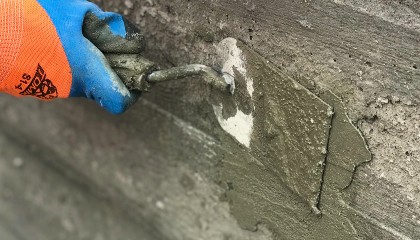 Having previously cleaned the hole and prepared the working composition according to the instructions indicated on the bag of material, the surface should be slightly moistened with water to ensure better adhesion. Next, using a spatula, you need to lay the repair compound in a hole with a thickness of no more than 40 mm.
If the length of the hole is more than 40 mm, then the repair work is carried out in several stages: fill the hole by 40 mm, wait for the material to dry completely (about 12-24 hours), mix the new repair compound in the same proportions and put the second layer with a spatula.
24 hours after the repair work is completed, the hole will be securely sealed and ready for operation.
